
Get Out
Rescission and Redemption for U.S. Investors in
Golden Visa Offerings
An early exit is not as easy as the entrance. Let’s find your basis to unwind.

Getting your capital back is not the same as coming out whole. U.S. tax can take a large share of the gain, and a flawed offering may give you grounds to unwind.
What began as a five-year path to citizenship may have become something else, with more risk, compounding U.S. tax exposure, longer capital deployment, and terms that may not be fit for purpose.
Common situations:
The issuer failed to disclose material facts, broke its promises, or violated the contract or the fund's management regulations
The developer missed buyback or delivery obligations
The U.S. tax exposure was misrepresented or misreported
The U.S. tax exposure is significant, compounds year over year, and exiting the investment is the only way to stop it from growing
The immigration authority failed you, turning a five-year expectation into a much longer capital deployment
The citizenship timeline no longer fits your life or or no longer matches what the issuer represented
Or some combination of these. We understand.
A flawed offering or sales process is one basis to unwind. Fraud, unregistered sales commissions, a developer's broken obligations, and foreign-law violations are others. A contract that reads as locking in investors may still be unwindable, and U.S. investors may have grounds to recover capital.
Our Record
The U.S. investors who used our analysis to pursue claims were made whole.
The U.S. tax exposure from Golden Visa qualifying investments is considerable. The U.S. regulatory compliance failures, material misrepresentations, and U.S. tax reporting errors in the Golden Visa market are widespread.
Our clients get clear on their tax exposure, investor rights, and leverage points. A private demand for unwind is sometimes enough. Other matters require counsel, in the issuer's jurisdiction or in the U.S. under SEC law. Statutes of limitations apply.
Investor protection is core to the mission of Golden Visa Direct. Our analysis maps the offering’s compliance with U.S. securities law, U.S. tax law, foreign securities law, fund management regulations, contract terms, and the deed and buyback obligations on real estate developments.

Why Start with Us
A lawyer will bill you to get up to speed on a market they've likely never seen. We already know the market. We've mapped many of the funds, managers, sponsors, and developers, and the specific ways their offerings fail U.S. investors.
Portugal, Italy, and Greece are small markets. Local counsel and issuers are often in the same circles. Our research answers to you alone and stays independent of those relationships.
With securities and tax training, and years spent inside this specific market, we speak every language in the room. The client's, the issuer's, counsel's, and the CPA's. We translate between them so nothing gets lost in the handoff and no one bills you to decode what someone else said. When you bring in counsel, and you should, they start from a documented factual record instead of a blank page.
When you work with Golden Visa Direct, you get the analysis that tells you whether you have a strong basis for a claim — and whether you're still in time to bring it across federal, state, and foreign jurisdictions — before you spend a dollar on retainers or litigation.
We've done this. Investors who acted on our analysis have recovered their full investment and avoided punitive U.S. tax exposure.
Investors anticipating litigation may prefer that their attorney engage us, so the analysis is performed under counsel's direction and may be protected as attorney work product.
The Cost of Holding On

Capital loss on the investment is an ongoing risk.
U.S. tax exposure is another ongoing risk, and it compounds over time.
If you made a QEF election and it is later invalidated, the investment defaults to the § 1291 excess distribution regime. The taxpayer then faces:
Tax at the highest ordinary rate, currently 37%, on the gain, plus
Interest that compounds daily across the full holding period. The longer the holding period, the higher the compounded interest. On a ten-year holding period, the interest on the earliest years alone can exceed the tax itself
Loss of the tax already paid on annual QEF inclusions. Under § 6511, a refund claim reaches back only three years; earlier inclusions are lost. For an investor who paid tax on significant annual inclusions, the loss risk can reach six figures
How likely the IRS is to look beyond the surface of a PFIC Annual Information Statement to test its validity for supporting a QEF election is something only the IRS can answer.
How comfortable you are carrying that risk is something only you can answer. In some cases, exiting the investment is the only way to stop the tax harm.
A Golden Visa Fund Investment Tax Illustration (slideshow)
An illustration of tax risk associated with a hypothetical 500,000€ Golden Visa fund investment held over ten years where QEF inclusions are made annually based on a fund manager issued PFIC AIS that does not meet U.S. regulatory standards, and where the QEF election is later deemed invalid and excess distribution tax treatment is applied.
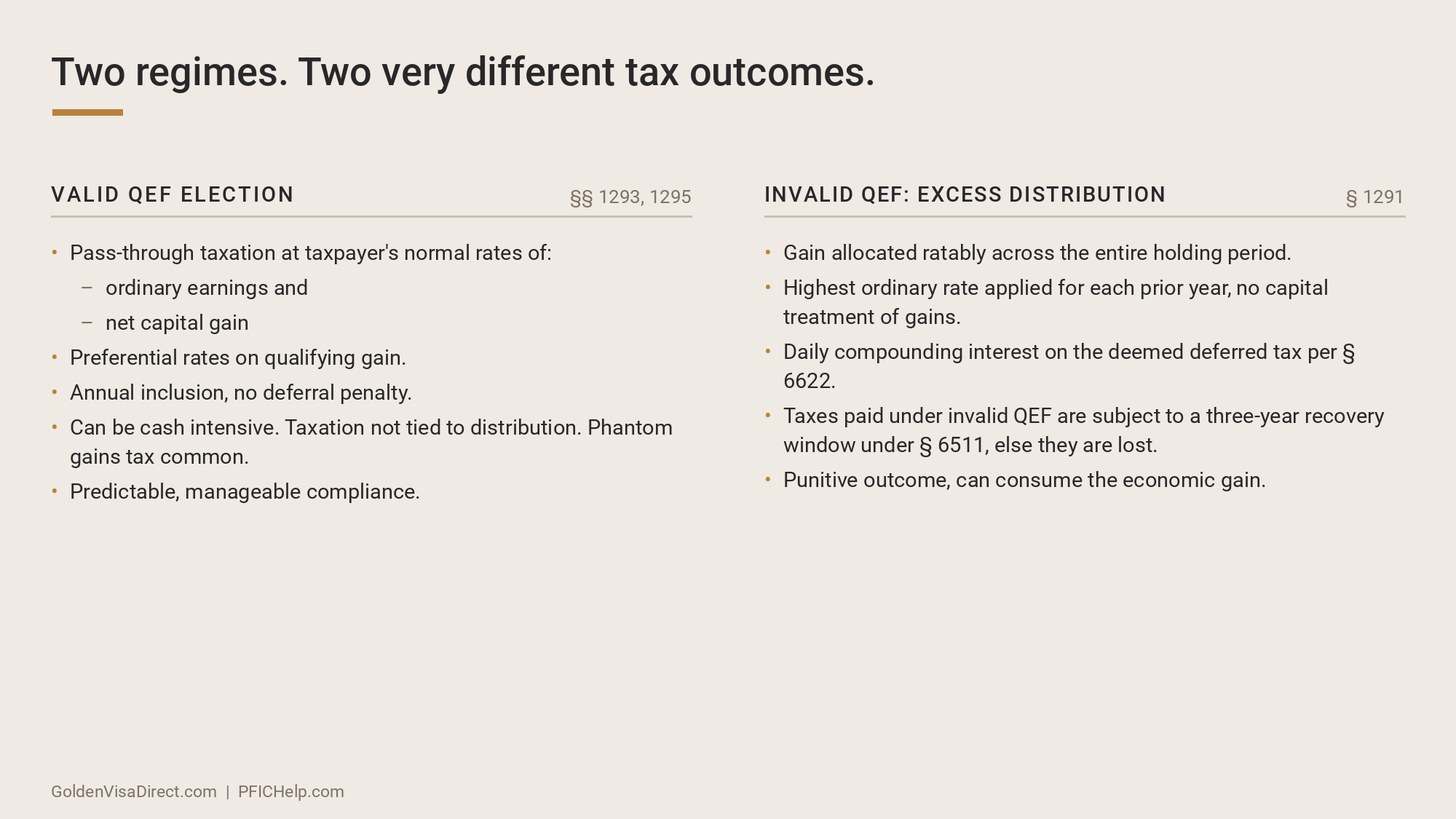
Two PFIC tax regimes compared. A valid QEF election gives pass-through taxation at ordinary and capital gain rates with annual inclusion. An invalid QEF causes the investment to default into the § 1291 excess distribution regime: gain spread across the holding period, taxed at the top ordinary rate, with daily compounding interest.
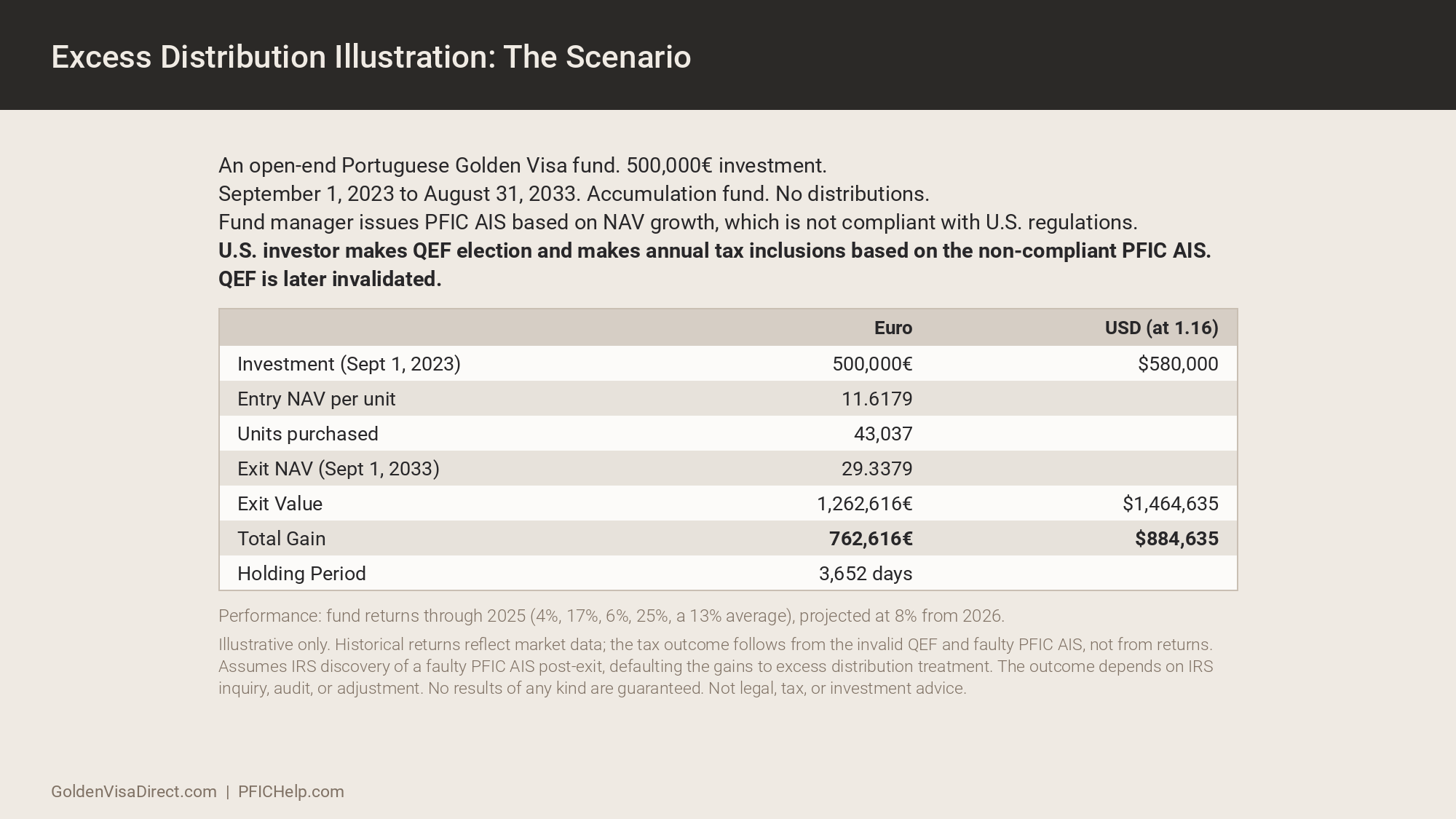
An open-end Portuguese Golden Visa fund, 500,000€ invested for ten years, no distributions. The fund issues a PFIC Annual Information Statement built on NAV growth. The investor makes a QEF election and makes tax inclusions each year based on the PFIC AIS, then the QEF is invalidated.
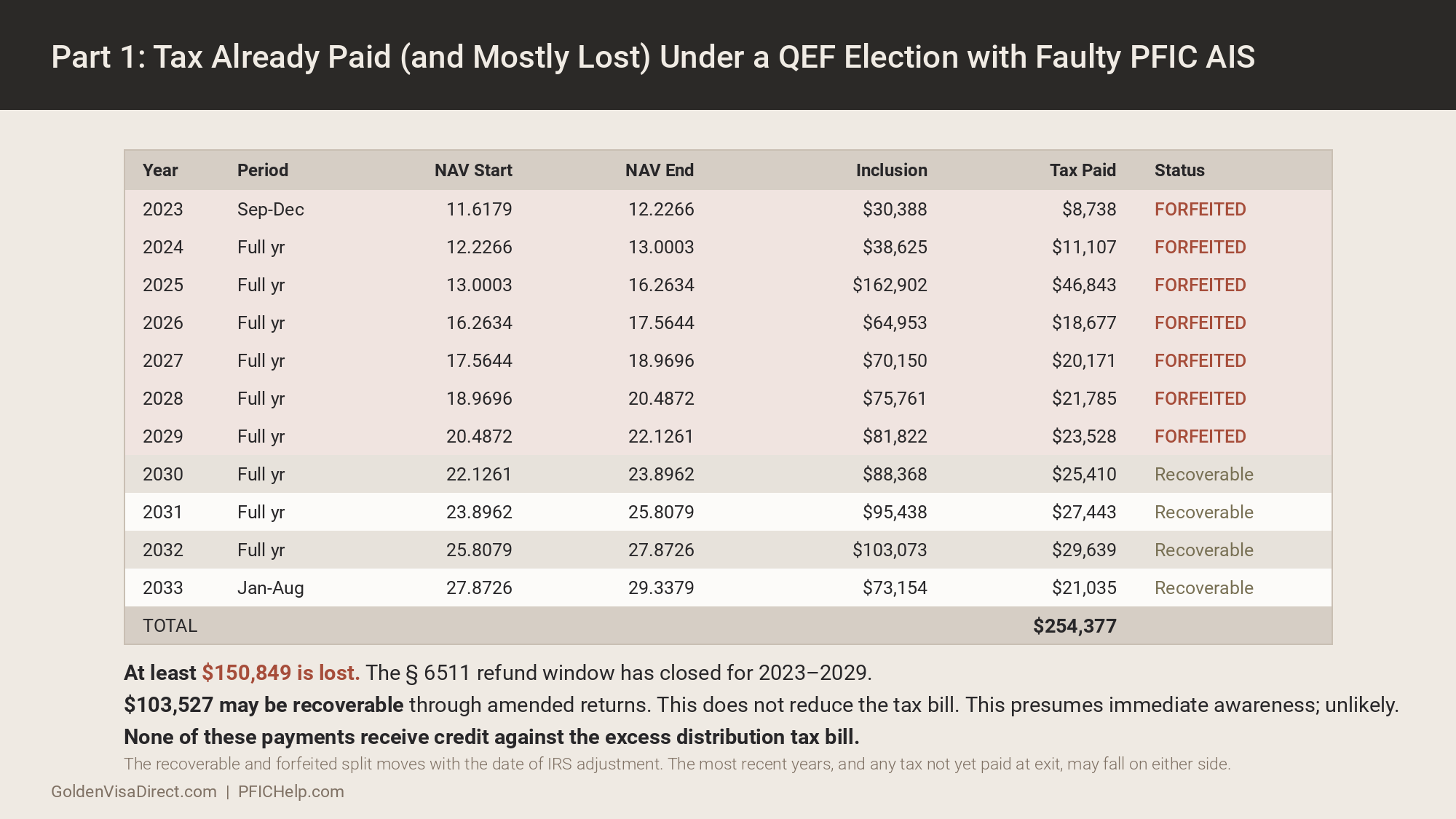
Under a QEF election built on a faulty PFIC AIS, the investor made $254,377 of tax inclusions over ten years. Once the § 6511 refund window closes (three years from filing, or two years from payment), at least $150,849 becomes unrecoverable, and none of it credits against the excess distribution bill at exit.
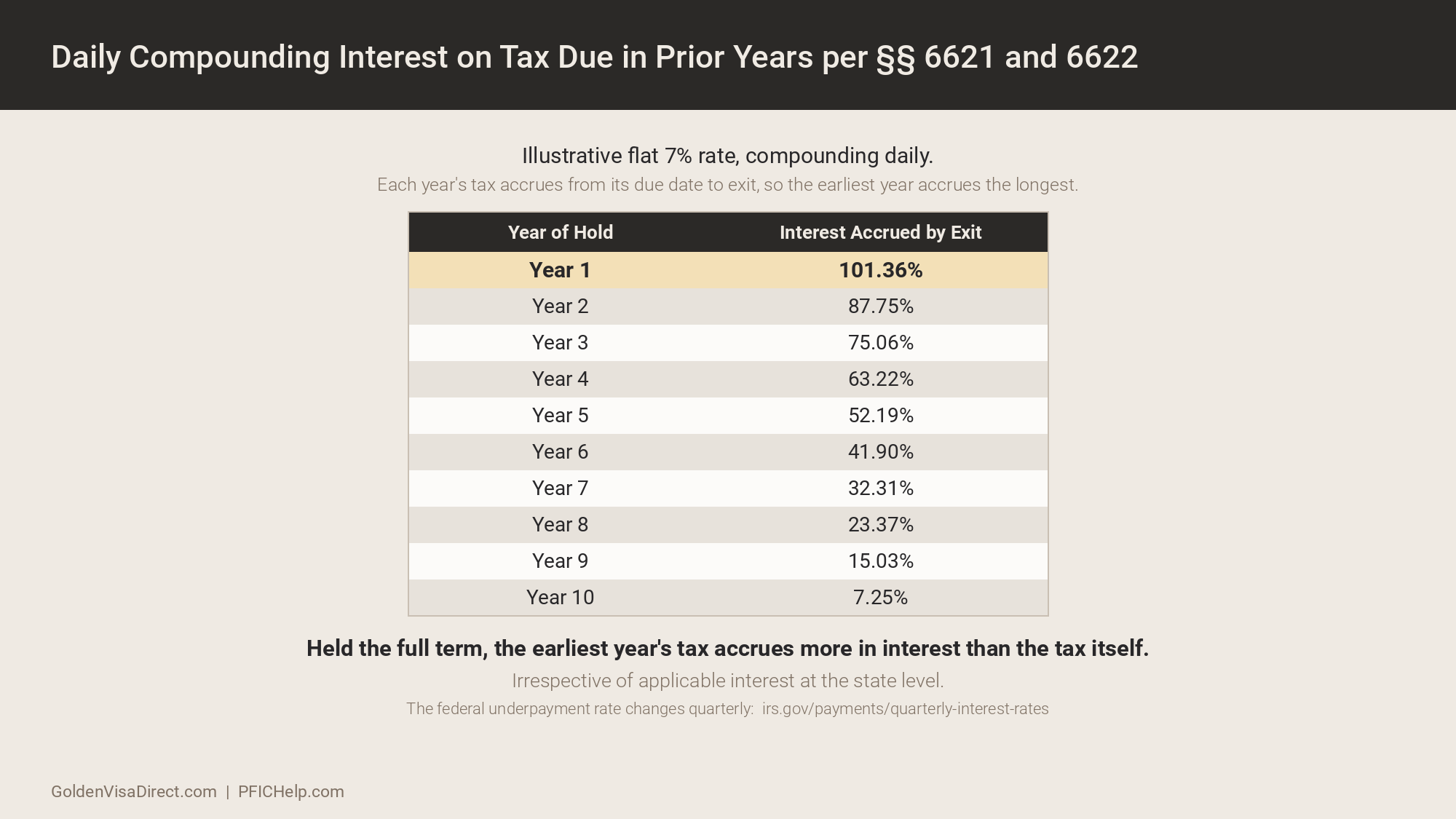
On an invalid QEF, each year's slice of excess distribution tax carries daily compounding interest from its due date to exit under IRS sections 6621 and 6622. At an illustrative flat 7% rate over ten years, the earliest year's tax more than doubles, accruing over 100% in interest.
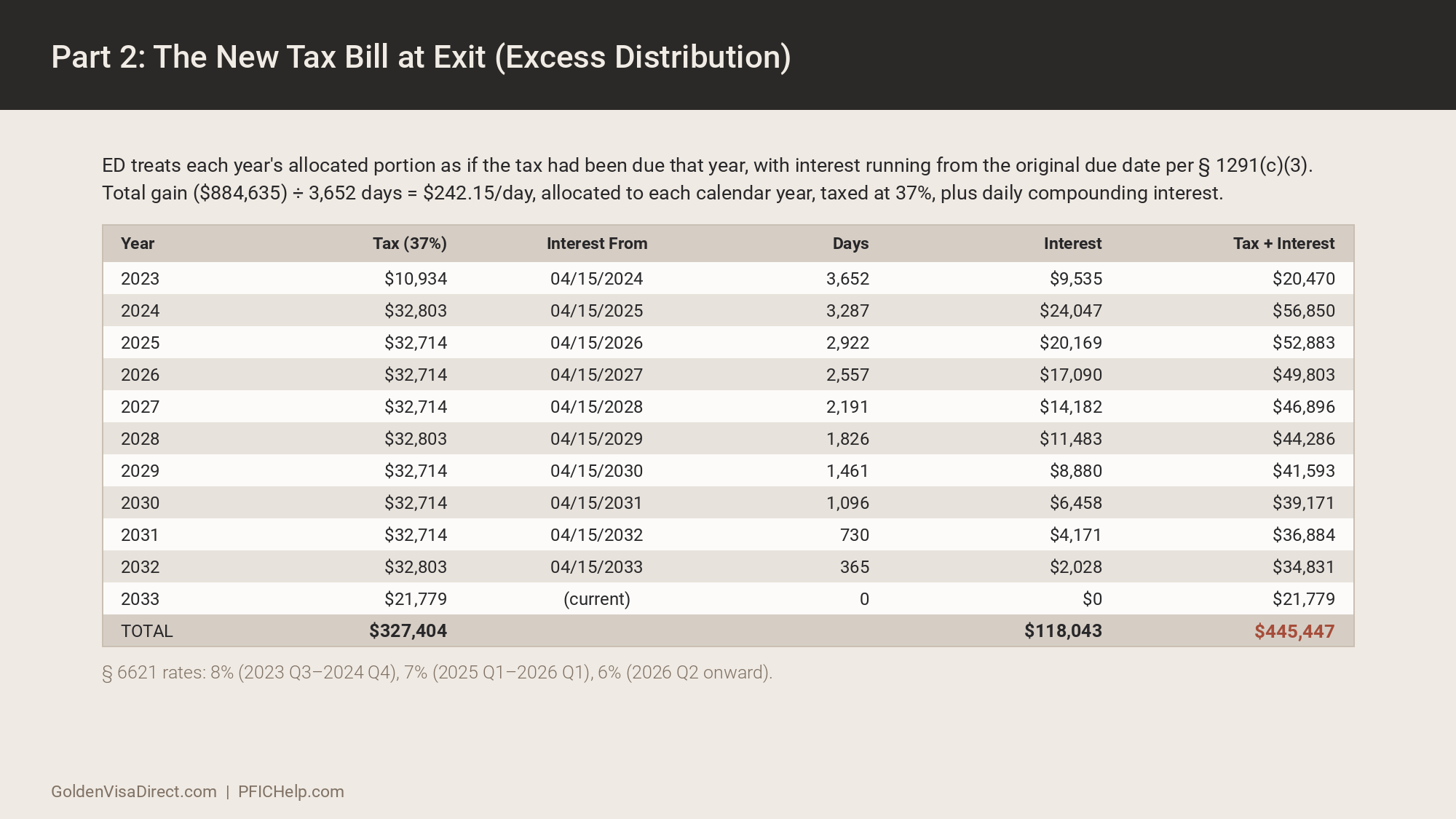
The excess distribution tax at exit. The $884,635 gain is spread across the ten-year holding period per IRC section 1291(c)(3), each year taxed at 37% with interest from its original due date, totaling $445,447 in tax and interest.
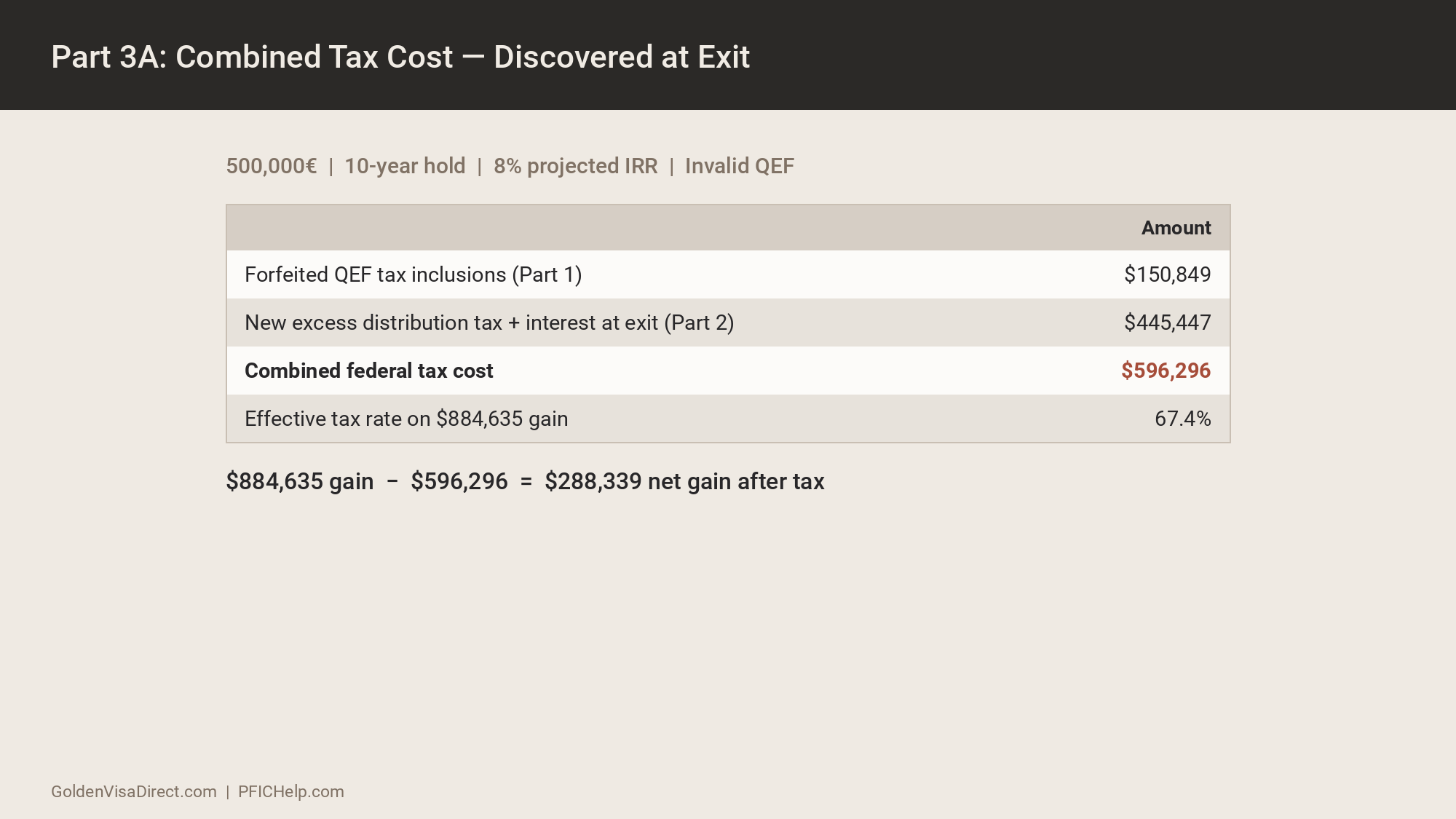
Combined tax cost when the faulty PFIC AIS surfaces at exit. Forfeited phantom gains tax of $150,849 plus the $445,447 excess distribution bill total $596,296, a 67.4% effective rate on the gain.
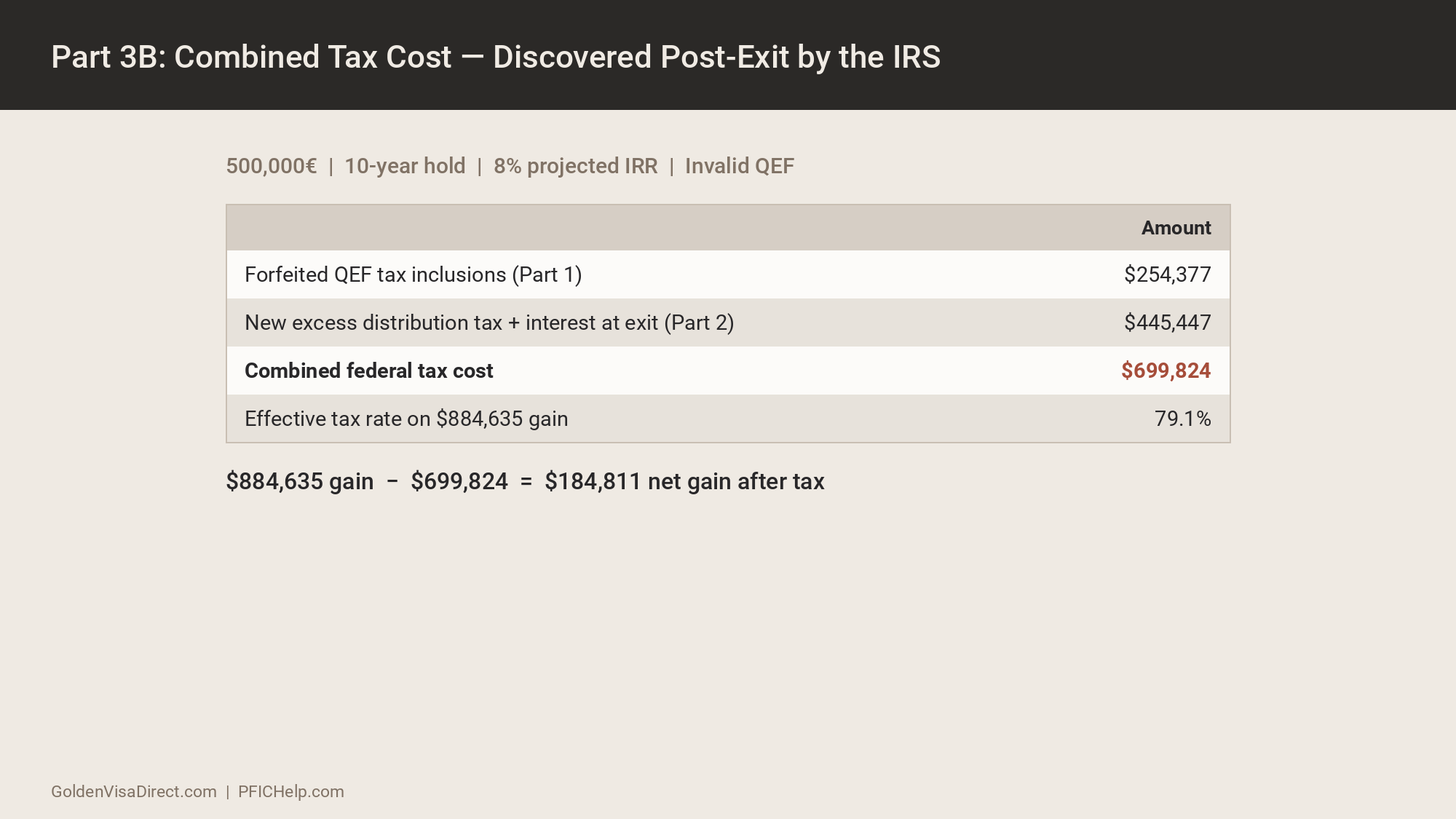
Combined tax cost when the IRS discovers the faulty PFIC AIS after exit, and every refund window is closed. Forfeited phantom gains tax of $254,377 plus the $445,447 excess distribution bill total $699,824, a 79.1% effective rate on the gain.
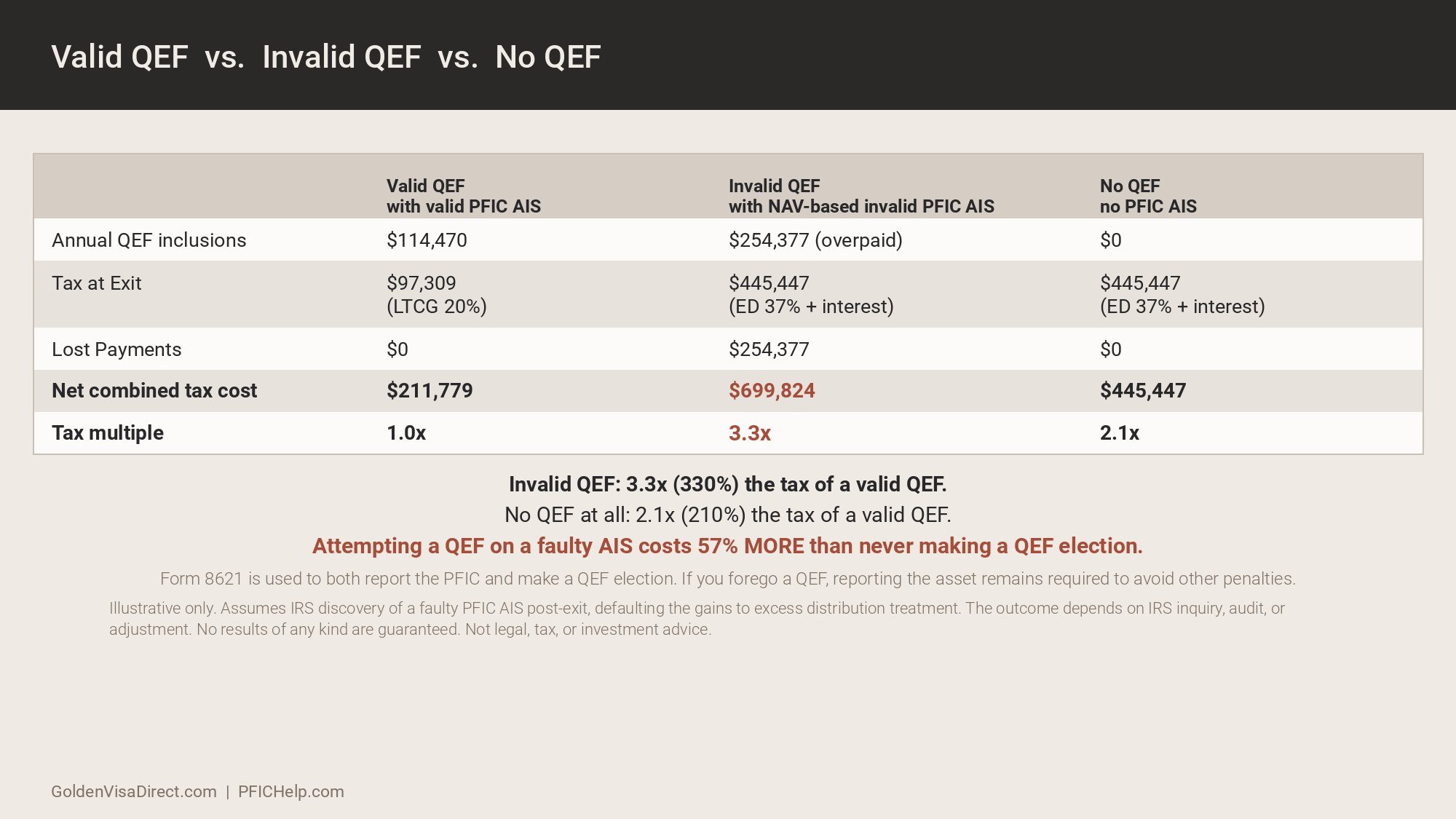
Valid QEF, invalid QEF, and no QEF side by side. An invalid QEF on a NAV-based faulty PFIC AIS costs 3.3 times a valid QEF and 57% more than never electing at all. Reporting the PFIC on Form 8621 stays required either way.
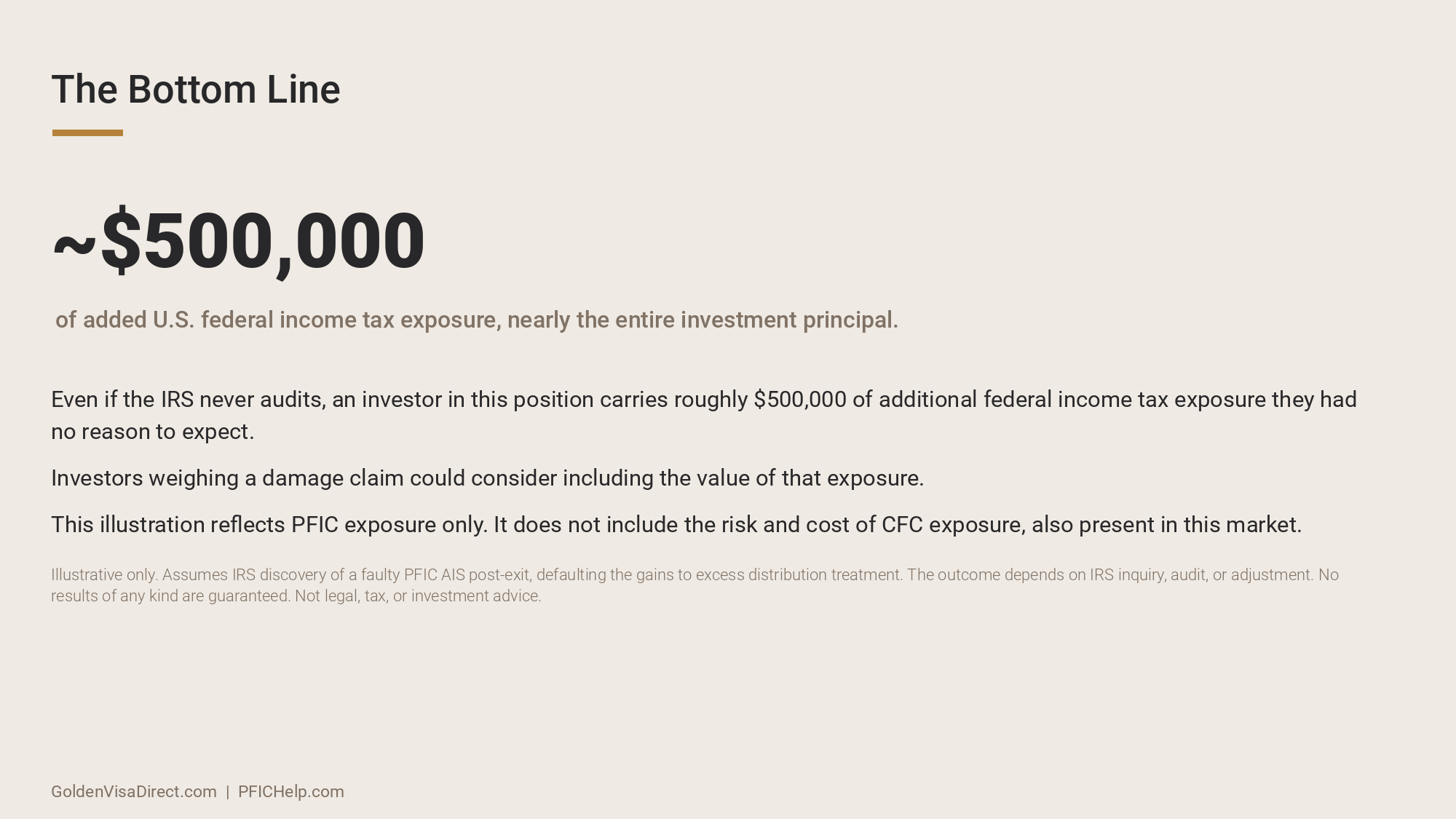
Even with no audit, a U.S. investor in this position carries roughly $500,000 of added federal income tax exposure, close to the value of the initial investment principal. Investors weighing a damage claim could consider including the value of that exposure. This illustration covers PFIC exposure only and leaves out CFC exposure, which is also present in this market.
Does a claim mean leaving the Golden Visa immigration program?
WHAT HAPPENS TO MY GOLDEN VISA RIGHTS IF I PURSUE A CLAIM?
Legal action and immigration process run in parallel. Pursuing a claim does not force you out of the program.
If you seek damages, your investment stays in place and your residency application continues.
If you unwind the investment, exit from the Golden Visa investor program occurs only after your capital is actually returned. Until then, you are free to stay in the immigration queue or Golden Visa program.
WHAT IS THE DIFFERENCE BETWEEN A DAMAGE CLAIM AND AN UNWIND?
An unwind, or rescission, returns your subscription capital under a legal claim that treats the transaction as reversed. Recovering the capital ends the qualifying investment, so the program exit follows.
Damage claims leave the investment in place and seek compensation for harm you have incurred. In this case, residency rights or applications remain unchanged.
The two claims usually proceed as alternatives, and counsel selects one.
WHEN DO I HAVE TO LEAVE THE GOLDEN VISA PROGRAM?
Only when the underlying investment is no longer active, meaning only once your capital is actually returned.
A claim can proceed for months while your immigration process stays in place.
For many investors, leaving is a relief on its own terms, since the five-year path they signed up for has already stretched toward sixteen.

Upstream Technical Analysis
for Golden Visa Investors
and their Counsel
We provide the specialized forensic analysis that sits upstream of legal strategy and recovery for U.S. investors in Golden Visa funds, start-ups, holding companies, and real estate developments.
Our reports give clients and counsel the documented foundation to:
Establish whether the offering and sales process broke U.S. securities law. Considerations include:
Securities Act § 12(a)(1) for an unregistered offering
Securities Act § 12(a)(2) for a misleading offering
Exchange Act §§ 15(a) and 29(b) for commissions paid to unregistered broker-dealers
Exchange Act Rule 10b-5 for fraud-based damage claims
Applicable foreign law and regulations
Isolate the specific misrepresentations or omissions that give rise to a claim to unwind
Ground rescission demands in independent forensic analysis rather than the accounts of the developer or fund manager
Document where the fund manager or developer failed its own obligations to investors
Build the evidentiary basis to power a redemption or rescission campaign
Support damages claims where the harm is financial, including U.S. tax exposure such as:
CFC: untested or misreported Controlled Foreign Corporation status
PFIC: defective Passive Foreign Investment Company reporting and QEF (Qualified Electing Fund) elections
IRA: deemed-distributed retirement accounts from § 4975 prohibited transactions and related § 408 custody and reporting failures
OID: unreported Original Issue Discount on developer debt
§ 6511: forfeited refunds on tax paid in error